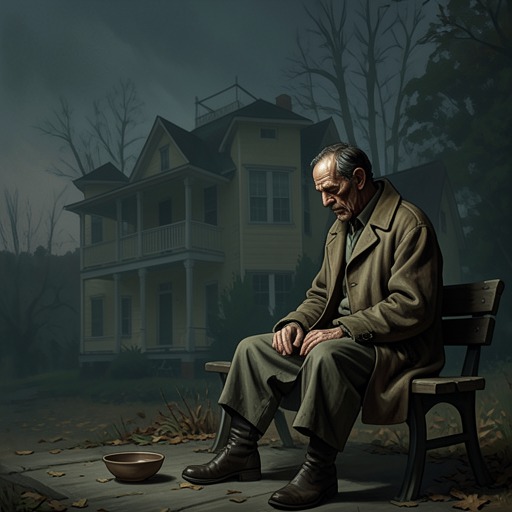
Fuga dello scudiero dai creditori
Lazarillo de TormesThe flight of the squire from his creditors, known by its fixed English title Fuga dello scudiero dai creditori, turns an eviction into a stark reversal of the usual master–servant order. When the landlord and the woman who rents the bed arrive to collect, the squire promises to change a coin and return; instead he vanishes. Lázaro, left with the key and an empty house, must answer for a debt he cannot pay and a household he never controlled.
The flight and the empty house
The crisis begins while Lázaro and his master are together in the house. A man demands the rent for the dwelling, and an old woman demands payment for the bed. Their account comes to more than the squire could have assembled in a year, though the sum for the two months is estimated at only twelve or thirteen reales. He answers that he will go to the market to change a double coin and asks them to return that evening. The explanation sounds like a promise of payment, but his departure is permanent.
The creditors return late in the evening. Lázaro says that his master has not come back, and, frightened to remain alone in the house after nightfall, he goes to sleep with the neighbouring women. The next morning, when the creditors come again, the women can offer them only Lázaro and the house key. The squire’s absence has made the boy the most visible person left to confront the claim, despite his having no authority over the debt or the means to settle it.
The creditors summon a constable and a clerk. With Lázaro and witnesses present, they take the key, open the door, and search the house for property that can be seized to discharge the debt. They find it completely empty. Their search turns an ordinary domestic space into a scene of attempted recovery: the officials have the legal authority to inventory and seize goods, but there are no goods to secure.
A legal search with nothing to seize
The officials ask where the squire’s trunks, tapestries, and furniture have gone. Lázaro answers that he knows nothing. They suspect that the possessions must have been removed during the night and order the constable to arrest the boy, assuming that he knows where they are. The constable grabs him by the collar of his jacket and threatens to detain him unless he confesses where the goods have been taken.
Lázaro is terrified. He recalls that he has been seized by the collar many times before, but then only because the blind man used to take hold of him to be shown the way. Now the gesture carries the force of arrest. Crying, he promises to answer their questions. The clerk sits down to write an inventory and asks what the squire owns, turning the threat of punishment into a demand for a formal account.
Lázaro replies that, according to what his master had told him, the squire possessed a rich building plot and a pigeon house in ruins. The officials initially treat this as promising evidence of recoverable property and ask where the land is. Lázaro says that it is in his master’s home village. His literal answer exposes the poverty behind the grand-sounding claim: the only assets he can name are distant, and one is already described as ruined. The inventory produces no usable path to payment.
The neighbours intervene to defend him. They tell the officials that Lázaro is an innocent child who has been with the squire only a few days and knows no more about him than they do. They explain that the boy used to come to their house, where they gave him what food they could for charity, and then went back to sleep at his master’s. Their testimony establishes that Lázaro had depended on their help even while he served the squire, and that his apparent place in the household never made him responsible for its finances.
Once the women’s account establishes his innocence, the officials release him. The constable and clerk then argue with the landlord and the old woman over their fee: the creditors say they should not have to pay because no goods were seized, while the officials protest that attending this case cost them another, more promising one. In the end, a guard takes the old woman’s red blanket, though the narrative treats it as a poor substitute for the missing property. The attempt to enforce the debt thus yields no possessions from the squire and leaves the smallest available object to absorb the dispute.
Abandonment and reversal
The episode’s conclusion makes explicit what the action has already shown: the squire has left Lázaro behind and escaped. Lázaro describes this as the full measure of his miserable fortune. In the usual arrangement, servants leave their masters; here, the master abandons the servant. The reversal is not abstract. The squire is gone, the house is empty, and Lázaro must stand among creditors and officials, answer questions, and rely on neighbours to prevent his arrest.
The contrast between the squire’s cultivated posture and his material circumstances sharpens the irony. His household cannot meet even two months’ rent, and the property supposedly available for repayment is a ruined pigeon house and a plot in another place. Yet the immediate burden of his flight falls on a child who has lived on food supplied by neighbours. The episode therefore exposes the distance between an appearance of social standing and the actual resources needed to sustain it, while showing how debt enforcement can reach the abandoned dependants who remain at the scene.
Lázaro’s account also connects this abandonment to a broader pattern of precarious survival. His father had been imprisoned for taking goods from the millers’ sacks and later died on an expedition against the Moors; after his death, his mother and Zaide supported the family through work and stolen supplies, until Zaide was punished and his mother sentenced. Later, when a poor harvest prompted Salamanca’s authorities to expel foreign beggars under threat of whipping, Lázaro’s household went hungry and neighbours’ small gifts helped him survive. The squire’s escape belongs to this chain of episodes in which poverty is not a single misfortune but a condition that shifts costs onto people with the least power to refuse them.
The episode also marks one stage in Lázaro’s changing relation to work and risk. After the squire leaves, he passes through further precarious service; later, he quits work as a constable’s guard after criminals attack him and his master with stones and clubs. He eventually finds a more stable livelihood selling water for a chapel priest: given a donkey, four jars, and a whip, he turns four years of earnings into second-hand clothes and an old sword, then gives up the trade. Against that later, limited ascent, the failed household search remains a lesson in the insecurity of serving someone whose status cannot protect either himself or the person dependent on him.
Narrative significance
The scene is told by Lázaro as part of his retrospective account of a life shaped by service, hunger, and unstable protection. Its comic turns—the supposed land and ruined pigeon house, the officials’ hopeful questions, and the old woman’s blanket seized at last—do not dissolve the danger. Lázaro is physically threatened with arrest, and his freedom depends on the neighbours’ intervention. Humour makes the mismatch between official procedure and actual poverty visible without making the boy’s exposure harmless.
The squire’s departure also revises the meaning of the household Lázaro had entered. A master who could offer no dependable food or rent money nevertheless occupied the position of protector, while the neighbouring women supplied actual meals. When the creditors arrive, that arrangement is laid bare: the boy has the key, but not the goods; the master has claimed property, but cannot be found; the neighbours, who were never his formal guardians, are the ones who speak for him. The flight ends the relationship by revealing who has borne its material costs all along.